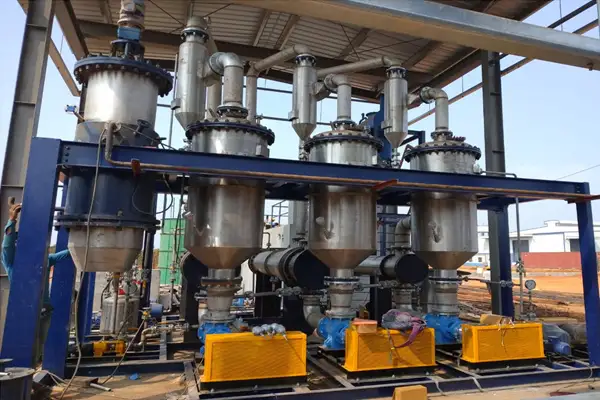
Pinakin Technology Solutions manufactures the multiple-effect evaporators, which is one of our best sellers. When customers are engaged, the product is at its finest. The vapour from one effect is used as the heat source for the next effect, which has a lower melting point. The high temperature in vapour may also be recycled by compressing it to a greater temperature and pressure, either thermally or manually. Multiple effect cooling systems have the benefit of being suitable for large-scale and continuous operation. When compared to a single effect, it is very cost effective. To reduce the energy required to evaporate unwanted water content, many effects are applied. The lack of sub-cooling of residue from several steam chambers in this multi-effect evaporator.
Vapor condensation occurs in a steam chest at a constant pressure. There really is no liquid droplet carry-over with the vapours leaving the corresponding effects. There is no heat dispersion into the environment. Evaporation is a unit process that uses heat transfer vaporisation to separate a liquid from solids. Evaporation is used to concentrate a solution containing a non-volatile solute (solids) and a solvent (liquid), which is usually water. The solute is condensed into a more viscous liquid product after a part of the solvent is evaporated. Evaporation is commonly used to make liquid concentrates in the food processing, petrochemical, paper, and medicinal sectors. Evaporation is distinct from dehydrating and dryness in that the final product is a concentrated liquid rather than a solid. If the liquid concentration is then dried using a technique like spray drying, evaporation can be utilized as the first stage in generating a dried product.
An MEE plant is an industrial system that concatenates multiple evaporator bodies to evaporate solvent (usually water) from a feed solution, optimizing thermal energy efficiency by reusing steam across consecutive stages.
In forward feed, liquid and steam flow in the same direction from high to low pressure; in backward feed, liquid flows from low to high pressure (against the steam flow), which is beneficial for highly viscous feeds as it finishes concentration at the highest temperature.
Fouling is managed by maintaining proper liquid velocities, performing scheduled Clean-in-Place (CIP) cycles, and choosing appropriate evaporator types (e.g., forced circulation for crystallizing stages).
Yes, Multi-Effect Evaporators can be integrated with Thermal Vapor Recompression (TVR) or Mechanical Vapor Recompression (MVR) systems to further reduce energy consumption by recompressing and reusing waste vapors.
All Copyrights © 2026. Pinakin Technology Solutions
Owned & Powered by : #1 Vinayak InfoSoft - SEO Company Ahmedabad || Disclaimer || sitemap